Every idle device, one pool of compute.
PoolIt lets the laptops, workstations and phones your team already owns lend a share of their RAM, CPU and GPU to train machine-learning models together. Owners choose how much to give. PoolIt handles the planning, the math and the network.
Move the work to the memory. Never the other way round.
Making a remote machine's RAM look local sounds elegant, but over a real office network it is far too slow to be useful.
PoolIt places pieces of the model where the memory already lives: full replicas on devices that can hold them, model stages or optimizer state on the rest. Only compressed gradients and activations cross the network. Training data never moves; each device regenerates its own slice from a shared seed.
That's how much slower the network is than memory on our reference laptop (HP EliteBook 830 G8, DDR4-3200). Every design decision starts from this gap.
Four lanes from spare hardware to a trained model
Install a node
A small tray app on each machine. Nodes find each other on the local network and agree on a coordinator.
Set a budget
Each owner caps RAM, CPU, GPU and network use, and can contribute only on AC power or only while the machine is idle.
Submit a job
Pick a model, optimizer and batch size. The planner splits each batch across devices in proportion to their measured speed.
Train together
Devices compute in parallel and swap compressed updates. Loss, accuracy and per-device timing stream live to the dashboard.
Depth markers from the current build
Every figure comes from a benchmark file produced in October 2026 on a single Intel Core i7-1165G7 laptop with integrated Iris Xe graphics.
Training throughput · large model · batch 512
samples / second
Baseline run of 1 October 2026, before the hand-tuned AVX2/AVX-512 CPU kernels landed. CPU numbers are a floor, not a ceiling.
Build a pool. Watch the honest math.
Integrated GPUs and phones use system RAM as GPU memory. A naive tally counts that memory twice and promises capacity that isn't there. PoolIt's planner counts it once.
Example devices. Toggle them and drag each owner's share.
Your pool
See every device, every job, every millisecond
A local dashboard shows the pool's topology, each member's contribution, and live training curves with a per-device split of compute time and network time.
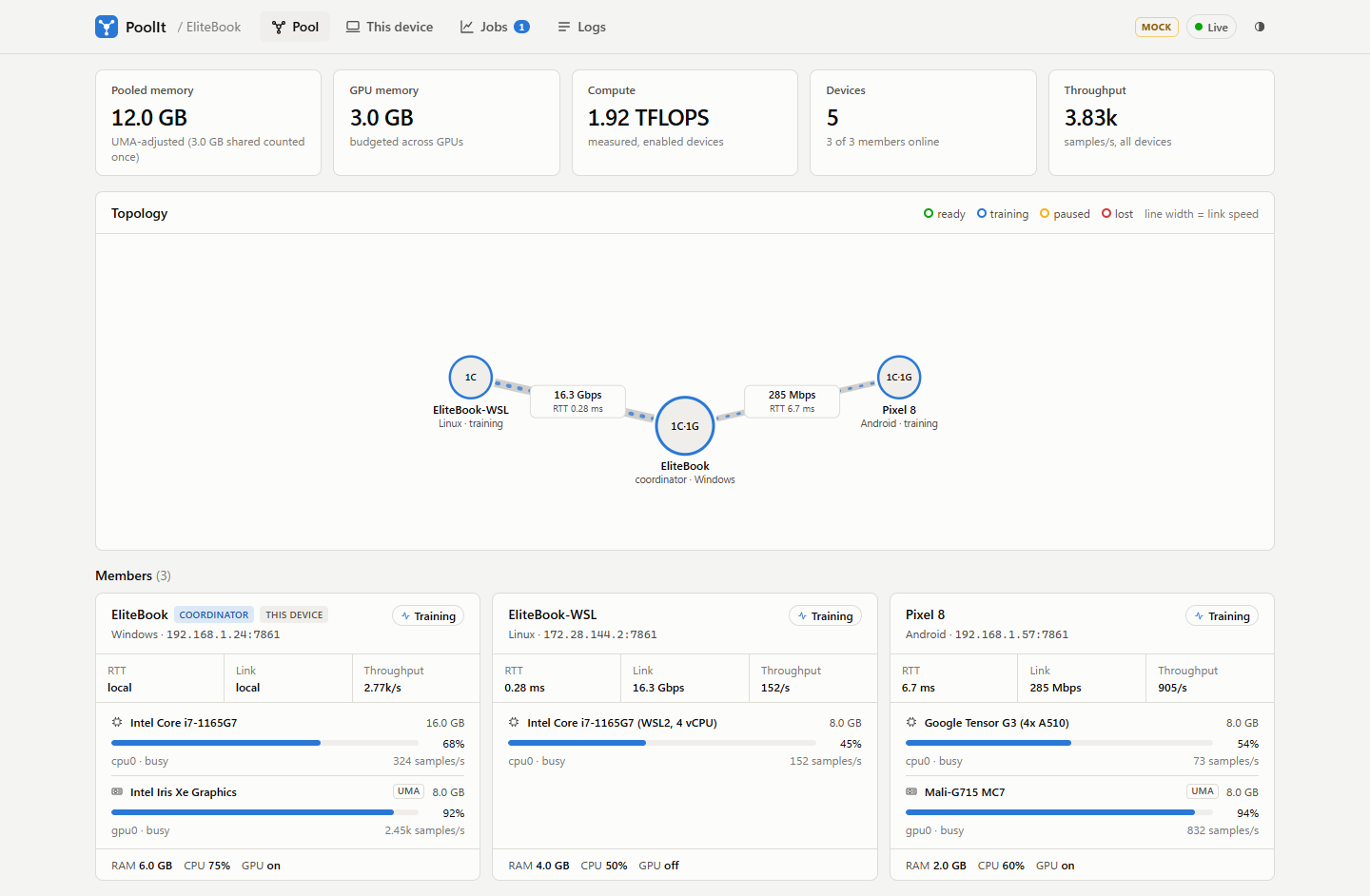
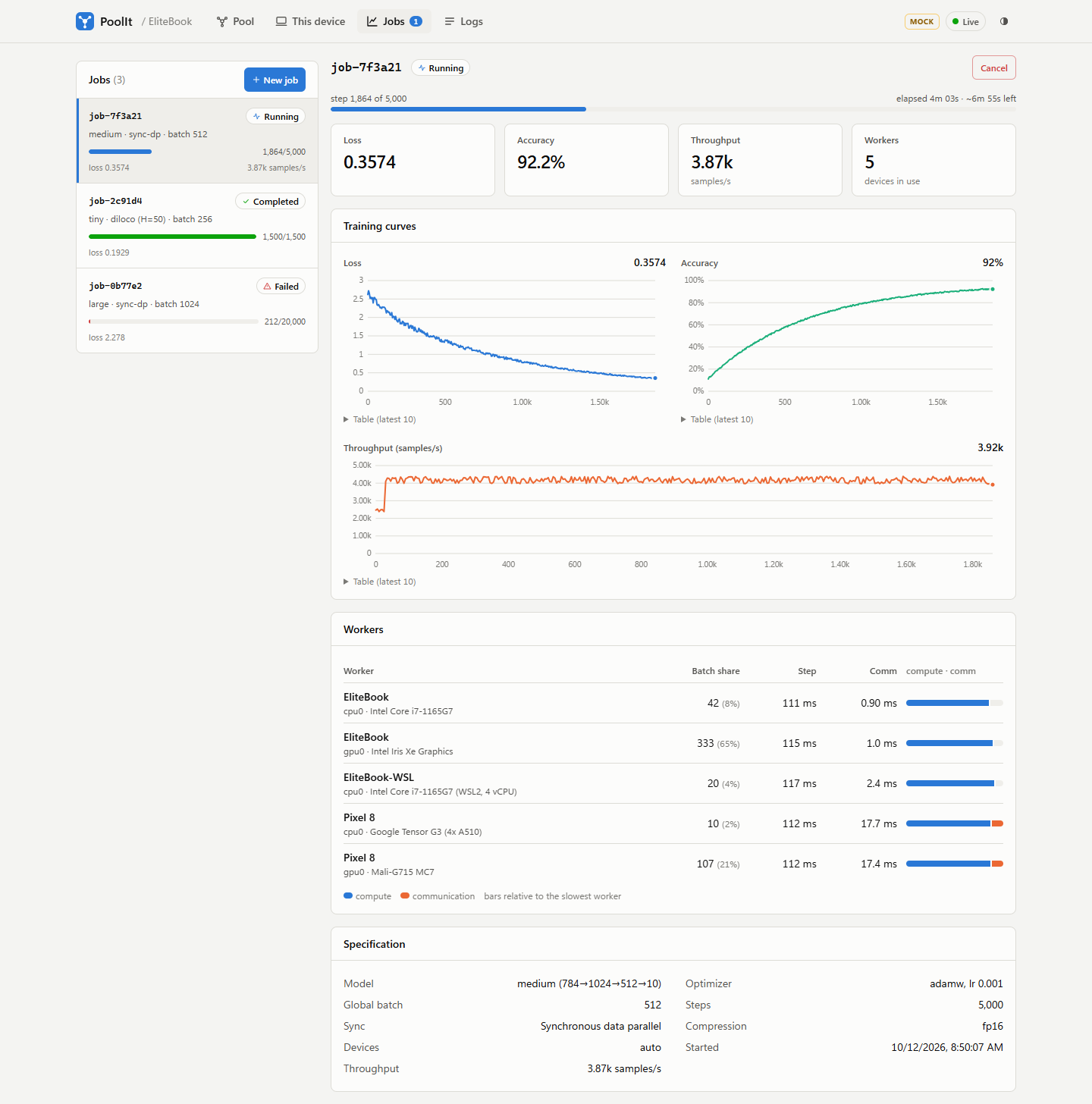
Screenshots use sample data to show a three-device pool.
Contributing never gets in the way of real work
Hard limits, enforced by the OS
On Windows the node runs inside a Job Object, so RAM, CPU and network caps are enforced by the operating system, not by good intentions.
Backs off automatically
PoolIt watches battery, temperature, fullscreen apps and idle time, and pauses or shrinks its share when the owner needs the machine.
Encrypted between devices
Nodes authenticate each other and encrypt traffic with the Noise protocol framework, built on the operating system's own crypto.
Your data stays put
Training data is never shipped across the network. Workers regenerate their own slice of the dataset from a shared seed.
Survives devices leaving
Checkpoints and stale-update rejection mean a laptop closing its lid slows a job down instead of breaking it.
No ML framework required
PoolIt's engine is its own C++ core with CPU and Vulkan backends. Nothing to install on each device beyond the node itself.
One core, every device you own
A single portable C++20 core runs everywhere. Each platform adds a thin layer for its OS and its GPU.
Windows
CPU (AVX2, AVX-512) and any Vulkan GPU, integrated graphics included
Linux
CPU and Vulkan GPU, including WSL2
Android
CPU (NEON) and Vulkan on phone GPUs
iOS · iPadOS
Metal on Apple GPUs
macOS
Metal
Run a pilot on your own fleet
If your team has laptops, workstations or test phones that sit idle for hours a day, a pilot shows how much training capacity they add up to, measured on your hardware and your network.
- We install PoolIt nodes on a handful of your machines, with budgets you choose.
- We benchmark each device and every link between them, and report the pool's real capacity.
- We train a model you care about and compare time and cost against your current setup.
- You keep the measurements, whatever you decide.